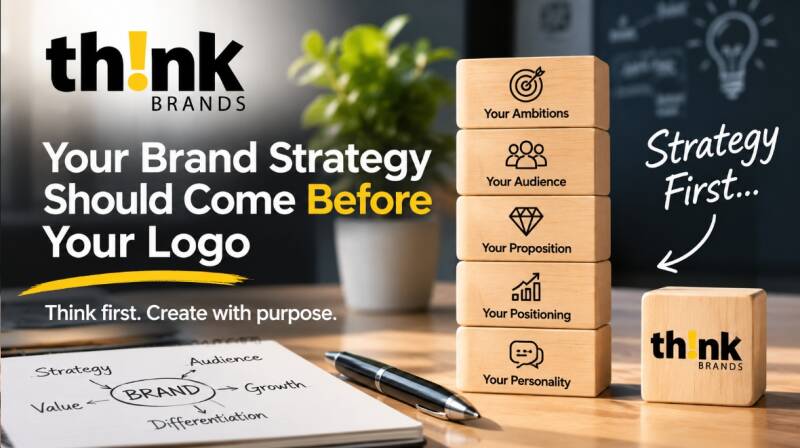

Thinking about a new logo? Before you brief a designer, make sure you know what your brand needs to say, who it needs to reach and what you want it to achieve.
It's an exciting moment for any business.
You've decided it's time for a new logo. Perhaps your existing identity looks dated, your business has evolved, you're launching something new or you simply feel your brand isn't doing you justice.
You start looking at designs, collecting inspiration and thinking about colours, fonts, symbols and styles.
But there's an important question you should answer first:
Do you actually know what your brand needs to stand for?
Because commissioning a logo before establishing your brand strategy is a little like designing the sign for a building before deciding what the building is going to be used for.
You might end up with something that looks impressive, but does it do the job?
At Think Brands, we believe that effective branding starts with thinking, not drawing. The creative work is important, but it needs to be built on a clear understanding of the business, its ambitions, its audience and its place in the marketplace.
A logo is not a brand strategy
A logo is an important part of your brand identity. It provides recognition, creates a visual signature and helps people identify your business.
But it cannot, on its own, explain:
-
What makes your business different.
-
Why customers should choose you.
-
Who your ideal customers really are.
-
What you want your business to become.
-
What reputation you want to build.
-
How you want people to feel when they encounter your business.
These are strategic questions, and they need answering before creative decisions are made.
Without that thinking, a logo is essentially an aesthetic exercise. It might look good, but it could just as easily belong to a completely different business.
The danger is that you end up with an identity that looks the part but doesn't communicate the right things, attract the right people or support the direction in which your business is heading.
1. Understand where your business is going
One of the first things to establish is what you want your business to become.
Your brand shouldn't simply reflect where you are today. It should provide a platform for where you want to go tomorrow.
Are you looking to:
-
Move into new markets?
-
Attract a different type of customer?
-
Introduce new products or services?
-
Move upmarket and command higher prices?
-
Grow from a local business into a national operation?
-
Become recognised as a specialist in your sector?
-
Prepare the business for expansion, investment or sale?
These ambitions matter because they influence the brand you need.
An identity that works perfectly for a small, local operation might not communicate the credibility, capability or confidence required of a business with national or international ambitions.
Equally, a brand that looks impressive but feels disconnected from the reality of your business can create expectations you struggle to fulfil.
Your strategy should establish the direction first, so the creative work can support it.
2. Know exactly who you are trying to reach
A brand needs an audience.
And while it can be tempting to say that your products or services are suitable for everyone, the reality is that the most effective brands understand who they are trying to influence.
Who are your customers? What matters to them? What problems are they trying to solve? What motivates their decisions? What makes them trust one business over another?
You also need to understand how they see your marketplace.
Are they looking for reassurance, innovation, value, quality, expertise, convenience or something else entirely?
A brand aimed at cost-conscious consumers will need to communicate differently from one targeting senior decision-makers in a specialist business-to-business market.
Understanding your audience helps determine the language, personality, positioning and visual character of your brand.
Without it, creative decisions are based on personal taste rather than customer relevance.
And your brand isn't there to satisfy the preferences of the person commissioning the logo. It's there to connect with the people who matter to your business.
3. Establish what makes you different
This is often where the most important strategic thinking takes place.
In almost every marketplace, businesses offer similar products or services. They compete for attention, customers and commercial opportunities.
So why should someone choose you?
Is it your experience? Your expertise? Your approach? Your service? Your product quality? Your values? Your understanding of a particular audience? Perhaps it's a combination of things that competitors cannot easily replicate.
Whatever it is, you need to identify it and understand how to communicate it.
This is your brand proposition: the reason your business should matter to its audience.
A proposition isn't simply a catchy slogan or a clever marketing phrase. It is a clear expression of the value you provide and the difference customers can expect.
When this is properly understood, it gives the creative process something meaningful to communicate.
Without it, a designer is left trying to make a business look different without knowing what genuinely makes it different.
4. Define your positioning in the marketplace
Brand positioning is about the place you want your business to occupy in the minds of your customers, relative to the alternatives available to them.
It influences how people perceive you, what they associate with you and whether they see you as the right choice.
Consider the difference between a business that wants to be perceived as:
-
Affordable and accessible.
-
Premium and exclusive.
-
Innovative and progressive.
-
Experienced and dependable.
-
Specialist and highly knowledgeable.
-
Friendly, approachable and personal.
Each position creates different expectations.
It also has implications for your visual identity, tone of voice, messaging, customer experience and marketing.
If you want to be seen as a premium specialist, your brand needs to support that position consistently. If you want to be recognised for accessibility and value, your identity and communications should reflect that instead.
The important thing is that your positioning is deliberate.
You should decide how you want to be perceived, rather than leave customers to make up their own minds.
5. Give your brand a personality and a voice
Brands are often described in human terms, and for good reason.
We form relationships with businesses in much the same way we form relationships with people. We respond to personality, behaviour, communication and consistency.
Is your business confident or understated? Traditional or progressive? Professional or informal? Challenging or reassuring? Innovative or dependable?
These characteristics help define your brand personality.
They also influence how your business communicates.
Your website, proposals, social media, emails, presentations, advertising and customer service should all feel as though they come from the same organisation.
This doesn't mean every communication needs to sound identical. It means there should be a recognisable character and consistency behind them.
A strong brand identity should express that personality visually, while the brand strategy ensures it is supported by the way the business actually behaves.
6. Get everyone pulling in the same direction
One of the biggest challenges in developing a brand is that different people within the same business can have very different ideas about what it represents.
The managing director may want to communicate experience and authority. The sales team may be focused on customer relationships. Marketing may want to appear innovative, while long-standing employees may feel the existing identity should be retained.
None of these perspectives is necessarily wrong.
But unless they are brought together, the result can be a fragmented brand that lacks clarity and consistency.
This is why brand strategy should involve the right stakeholders.
At Think Brands, we use Brand Workshops to bring people together, explore the current situation, challenge assumptions and co-create a shared vision of what the brand needs to become.
The process helps establish:
-
A shared understanding of the business and its marketplace.
-
The views and expectations of key stakeholders.
-
The business's ambitions and future direction.
-
Its audience, proposition and competitive positioning.
-
The personality and character the brand should communicate.
-
An agreed specification or creative brief.
The outcome is more than a list of design preferences.
It is a strategic foundation that everyone can understand, contribute to and support.
7. Turn strategy into creative direction
Once the strategic thinking is complete, the creative process becomes much more purposeful.
The designer is no longer being asked to create something that simply looks good.
They are being given a clear understanding of:
-
The business and its ambitions.
-
The audience the brand needs to connect with.
-
The market position it needs to establish.
-
The proposition it needs to communicate.
-
The personality it needs to express.
-
The practical environments in which the identity will be used.
This provides boundaries, direction and a meaningful basis for creative decisions.
It also makes it easier to evaluate the work.
Instead of asking whether someone likes a particular colour or symbol, you can ask whether the design communicates the right message, supports the desired positioning and connects with the intended audience.
That is a much more productive way to develop a brand.
What happens when you get it the wrong way round?
When businesses start with the logo rather than the strategy, a familiar pattern can emerge.
The design is developed, opinions are exchanged, colours are changed, concepts are rejected and new ideas are introduced.
Eventually, something is agreed.
But then the questions start.
The website doesn't quite communicate the right message. The sales team isn't sure how to describe the business. The marketing looks inconsistent. The new identity doesn't seem to attract the customers the business wanted. The business itself has changed, but the brand hasn't kept up.
The problem may not be the design.
It may be that the design was asked to solve a strategic problem it was never equipped to solve.
This can result in wasted time, additional creative costs and, ultimately, the need to do the work again.
A little strategic thinking at the beginning can save a considerable amount of correction later.
Your brand needs to work harder than your logo
A successful brand is much more than a visual identity.
It is the combination of strategy, positioning, messaging, creative identity, customer experience, reputation and the way the business consistently presents itself.
It needs to work across every touchpoint, from the first time someone encounters your business to the moment they become a loyal customer.
It also needs to be owned and protected.
Once your brand identity has been created, it is important to establish who owns the intellectual property behind it, ensure the appropriate rights have been assigned and consider whether names, logos and other distinctive identifiers should be registered as trade marks.
After all, you are investing in building a valuable business asset. You should understand what it stands for, who it belongs to and how it is protected.
Think first. Create with purpose.
At Think Brands, we believe the best creative work starts with the right questions.
Before developing an identity, we want to understand the business, its ambitions, its customers, its marketplace and what it needs its brand to achieve.
Our approach brings together brand strategy, collaborative workshops, creative development and brand ownership expertise.
We help businesses define what they stand for, establish where they want to go, create an identity that communicates their value and put the right foundations in place to own, protect and manage their brand.
Because a logo might be the first thing people see.
But the thinking behind it is what makes it meaningful.
Don't start by asking what your logo should look like. Start by asking what your brand needs to achieve.
Think Brands – Define. Create. Own. Protect. Manage. Grow.
Planning a rebrand?
Before commissioning creative work, make sure you have the strategy to support it.
Talk to Think Brands about a Brand Workshop and discover how the right thinking at the outset can create a stronger, more purposeful brand.